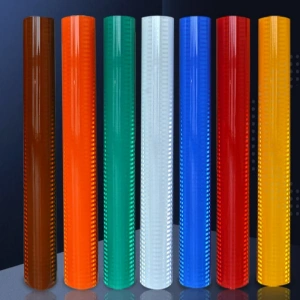
Traffic reflective film (often called retroreflective sheeting) is a specialized material crucial for modern traffic safety. It’s engineered to return light directly back to its source (like car headlights), making signs, vehicles, and objects highly visible at night.
Reflective Film Components
- Retroreflective Elements: Microscopic glass beads or prismatic structures that bend light.
- Protective Surface: A transparent top film (often a ceramic-coated plastic) for durability.
- Color Layer: Pigmented middle layer (white, yellow, red, blue, green, etc.).
- Adhesive Layer: High-bond pressure-sensitive adhesive for mounting.
- Liner: Protective backing paper removed during application.
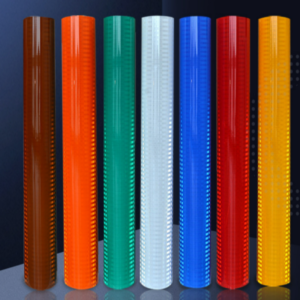
Reflective Film Major Types
Performance is graded by luminous intensity (candelas per lux per m²). Higher grades
are brighter and have longer effective distances.
1. Advertising Grade (Type I)
- Luminous intensity: ≥70 candelas per lux per m²
- Technology: Glass-bead embedded in a plastic binder.
- Performance: Entry-level, lowest retroreflectivity. Short service life.
- Typical Use: Low-speed roads, parking signs, temporary signs, non-critical applications.
2. Engineering Grade (Type II)
- Luminous intensity: ≥70 candelas per lux per m²
- Technology: Glass-bead embedded in a plastic binder.
- Performance: Entry-level, lowest retroreflectivity. Short service life.
- Typical Use: Low-speed roads, village, residential community, temporary signs, non-critical applications.
3. Super Engineering Grade (Type II)
- Luminous intensity: ≥140 candelas per lux per m²
- Technology: Glass-bead embedded in a plastic binder.
- Performance: Entry-level, lowest retroreflectivity. Short service life.
- Typical Use: National and provincial highways.
4. High-Intensity Prismatic (HIP) (Type III)
- Luminous intensity: ≥250 candelas per lux per m²
- Technology: Microprismatic structure (engineered plastic cubes).
- Performance: Very bright, long-distance visibility (over 800 meters). Good angularity.
- Typical Use: Most regulatory and warning signs (stop, yield, speed limit), guide signs on highways. The most common film for permanent traffic signs.
5. Super Prismatic (HIP) (Type IV)
- Luminous intensity: ≥360 candelas per lux per m²
- Technology: Microprismatic structure (engineered plastic cubes).
- Performance: Very bright, long-distance visibility (over 800 meters). Good angularity.
- Typical Use: Most regulatory and warning signs (stop, yield, speed limit), guide signs on highways. The most common film for permanent traffic signs.
6. Diamond Grade (DG) / Microprismatic (Type V)
- Luminous intensity: ≥580 candelas per lux per m²
- Technology: Advanced full-cube microprisms.
- Performance: Ultra-bright, superior wide-angle performance, longest viewing distance. Highly durable (10+ years).
- Typical Use: Overhead freeway guide signs, critical warning signs, complex interchanges. Often used with fluorescent yellow-green for school/pedestrian signs.
Reflective Film Main Application Places
1. Road Traffic Signs (Primary Use)
- Regulatory Signs (Stop, Yield, Speed Limits)
- Warning Signs (Curve, Pedestrian, Intersection)
- Guide Signs (Street names, Route shields, Distance signs)
- Construction/Temporary Signs
2. Vehicle Marking & Conspicuity
- Truck/Trailer Conspicuity Tape: Red/White or Yellow alternating strips (regulated by FMVSS 108). Mandatory on trailers and large trucks in many countries to outline their shape at night.
- Emergency & Work Vehicles: Striping on police cars, fire trucks, ambulances, snow plows, and utility vehicles.
- Bicycles & Pedestrians: Reflective stickers on bike frames, helmets, and on safety vests/clothing.
3. Roadway Markers & Delineators
- Post-Mounted Delineators: On guardrails, curves, and barriers.
- Channelizing Devices: On barrels, drums, and barricades.
- Bollards & Flexible Posts: For lane separation.
4. Roadway Markers & Delineators
- Post-Mounted Delineators: On guardrails, curves, and barriers.
- Channelizing Devices: On barrels, drums, and barricades.
- Bollards & Flexible Posts: For lane separation.
Reflective Film Standards & Regulations
- China: GB/T 18833-2012
- USA: MUTCD (Manual on Uniform Traffic Control Devices) dictates color, reflectivity, and placement. ASTM D4956 defines performance classes.
- Europe: EN 12899-1 standard.
- Global: Many countries adopt or adapt US/European standards.
Why It's Critical
Traffic reflective film is a passive safety technology that works 24/7 without power. It drastically reduces nighttime crashes by providing drivers with critical visual information exactly when and where they need it, buying precious seconds of reaction time.
In short, it’s the unsung hero of road safety, transforming ordinary sheets of plastic into potentially life-saving visual guides for nighttime navigation.